DHL’s new Trend Radar puts AI action and workforce readiness on the logistics agenda
AI flagging a shortage and AI placing an order are different propositions. DHL’s new Trend Radar puts action, oversight and workforce readiness in focus.
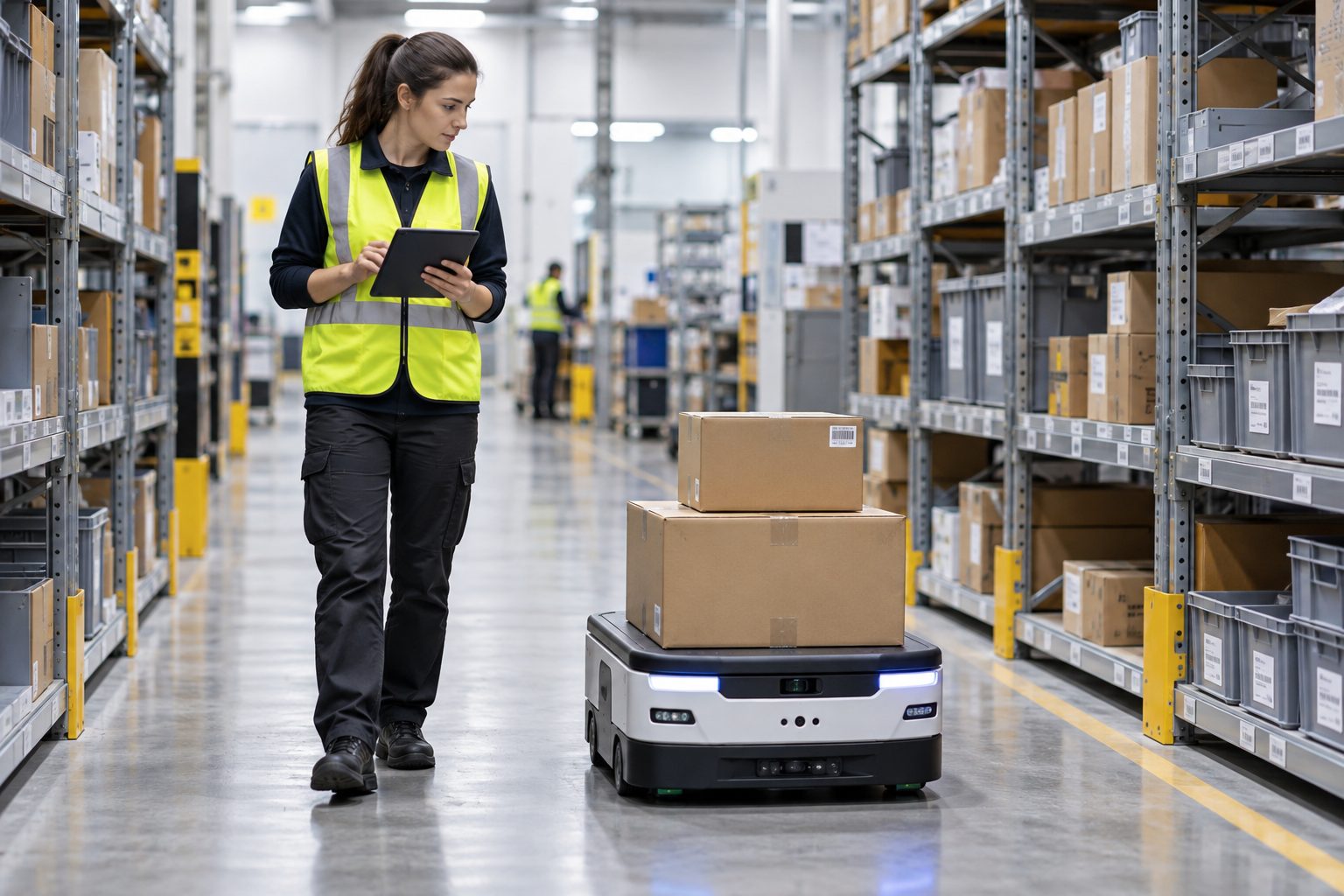
Image: AI-generated illustration of a worker supervising warehouse automation; not a photograph of a DHL facility or deployed DHL system.
There is a large difference between software telling a buyer that stock is low and software placing the next order. DHL’s Logistics Trend Radar 8.0, announced on 24 September 2026, brings that distinction into focus. The new edition adds Agentic AI, AI Commerce, Compute Economy and Humanoids to its trend map, while putting workforce skills and oversight alongside them. For a goods business, the interesting question is where advice should become permission to act.
The report points to a direction
DHL describes agentic systems as capable of planning and acting towards goals with human oversight. Its announcement also highlights worker support, responsible AI and cybersecurity. The Radar is a forward-looking research initiative; it is not a guarantee that every described technology is already available, suitable or economical for a particular warehouse.
Treat the Radar as a map of directions to explore, rather than a shopping list of systems ready for your warehouse. A promising technology still has to fit the work, cost and people involved. Starting with a familiar operational problem makes the discussion more useful than starting with the most impressive demonstration.
Take a stock shortage. A system could flag it to a buyer, prepare a purchase order, send that order or change a customer’s delivery promise. Those actions carry very different consequences. Decide which one you want before asking what the software can do. If an action would be expensive or difficult to reverse, the approval around it deserves particular attention.
A narrow pilot can help. For example, ask a system to prepare a replenishment recommendation for a limited range while an employee still approves the order. Record why a recommendation was accepted or rejected. This hypothetical approach measures whether the process is useful before giving the system broader authority.
What is the system acting on?
An automated workflow can act quickly on an incorrect stock balance, an outdated lead time or the wrong pack size. Speed does not remove those errors. Review the input records and decide which source is authoritative for quantity, reservation, price and delivery status. Where a field is uncertain, the system needs a way to pause or escalate.
A purchasing assistant may see a shortage that has already been solved by an inbound delivery if the receipt has not reached the system. That is a timing problem, not necessarily a forecasting problem. Trace the information through the real workflow. Adding more intelligence to a stale record does not make the underlying stock balance dependable.
Separate actions that merely read or prepare information from actions that change orders or communicate commitments. Set clear limits by product, quantity, account and value where appropriate. An employee should be able to understand which permissions apply without reading a technical configuration file.
Keep a record of changes and provide a practical stop mechanism. If a repeated error appears, staff need to halt the workflow and identify affected transactions. A process that produces useful suggestions but leaves nobody able to explain a change is difficult to trust when customer orders are involved.
Staff training should include what the system cannot decide confidently. A damaged receipt, disputed quantity or unusual customer request may need human judgement even if routine transactions are automated. Give employees a clear escalation route and enough context to resolve an exception rather than simply passing it between teams.
Ask the people doing the work which repeated tasks create delays and which informal checks currently prevent errors. Those observations can shape a more useful pilot. Automation that removes a tedious step but also removes an important verification may improve the dashboard while making the operation less dependable.
Ask the people doing the job where the repeated work is tedious and where a small informal check prevents an expensive mistake. Then test one bounded process, including its exceptions, against a clear baseline. DHL’s report points towards more capable systems. Whether those systems improve a particular warehouse will depend on the less glamorous work around them: reliable records, clear authority and staff who can recognise when to intervene.
Source: DHL Logistics Trend Radar 8.0 announcement, 24 September 2026.