Packaging trials: how to compare protection, packing time and delivery cost
A cheaper carton may create a dearer parcel. Test packing time, transport charges and arrival condition before calling the change a saving.
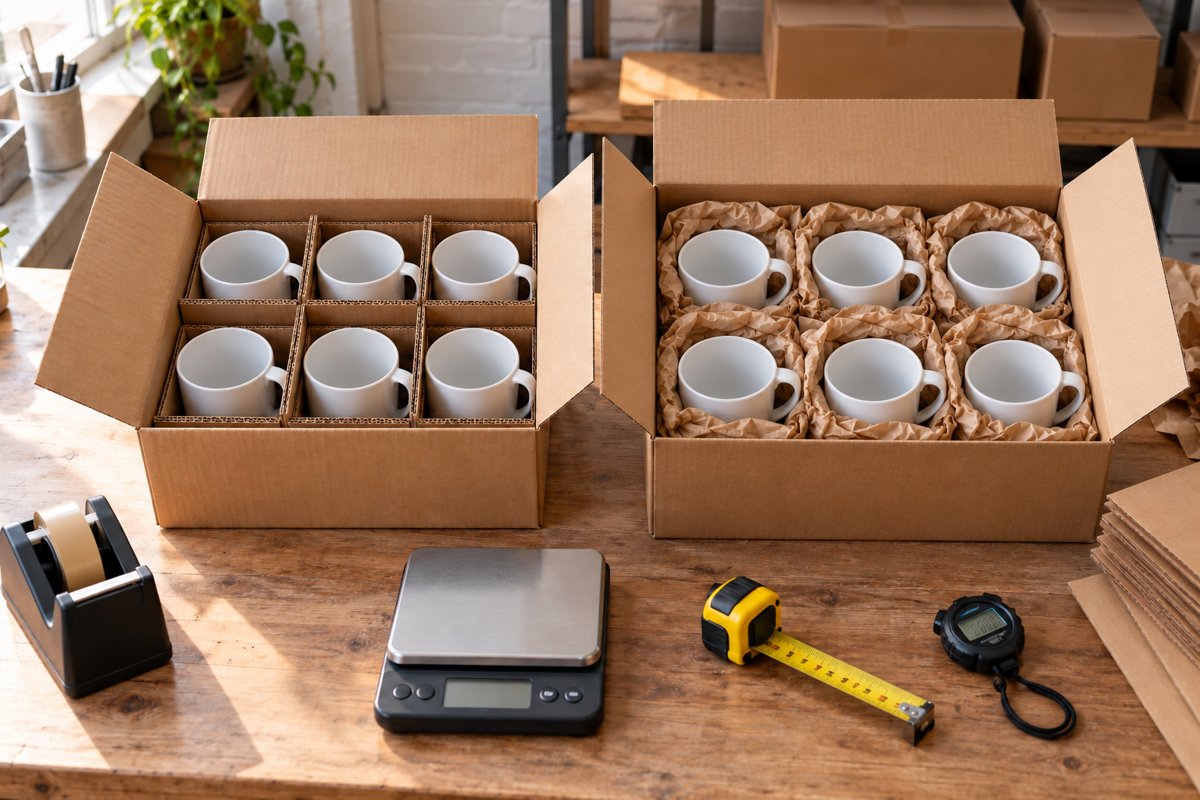
AI-generated illustration of two packaging methods for a six-mug order.
The new carton costs less. Then it takes longer to assemble, needs extra cushioning and produces a larger parcel. Has the packaging become cheaper? Not necessarily. The purchase price is just the first cost in a journey that runs from the packing bench to the customer opening the box. A useful trial follows that whole journey instead of declaring a saving when the carton invoice arrives.
Start with the product, the order quantity and the delivery route. Note vulnerable parts, movement inside the box, moisture sensitivity and any accessories that need to remain together. A single fragile item and a mixed carton of durable products may need different solutions even when their outer dimensions are similar.
Record the current problem you are trying to solve. It might be excessive material use, recurring corner damage, too much empty space or slow packing. Give the trial a measurable objective, such as reducing packing time without increasing damage. Avoid trying to change every aspect at once, because that makes the results difficult to interpret.
Select a small group of representative orders and record the product configuration in each. Keep a baseline using the current packaging and a trial group using the proposed version. If one group contains more fragile products or travels on a different route, the difference may reflect those factors rather than the packaging.
For example, take the same six-mug order and compare two packing methods. Record the carton, dividers, cushioning and closure in each. Keep the route and product configuration comparable. The aim is not to find a universally perfect material; it is to find a method your team can repeat and a result you can explain.
Record the time needed to prepare materials, pack the order, seal it and apply labels. Include rework when a configuration is difficult to assemble consistently. Ask different trained staff to use the proposed method so the result does not depend on one particularly experienced packer.
Watch what happens before the finished parcel appears. Does someone have to fetch a special insert, fold awkward parts or clear extra bench space? A carton can be quick to seal and slow to prepare. Ask more than one trained packer to try it. A method that works brilliantly for its designer may be much harder for the rest of the shift.
Price the parcel you actually send
Measure and weigh the completed parcel, including all materials. Ask the carrier or fulfilment provider how that package is charged under your actual service and agreement. Delivery pricing can depend on dimensions as well as weight, so a small change in box size may affect the quoted cost.
Do not assume that a formula or divisor used by one provider applies to another. Use the current tariff or quotation for the route and service being tested. For mixed orders, include several common configurations rather than treating one convenient parcel as representative of the whole business.
Ask receiving customers or trial destinations to record the outer packaging and the goods on arrival. Capture damage, movement, missing accessories and any difficulty identifying the order. Keep photographs linked to the packing version and shipment reference. An unexplained complaint cannot tell you which configuration needs to change.
No damage in a small trial is encouraging, but it is not a guarantee for every route or order. Keep the sample size and handling conditions in view, and obtain specialist testing where the goods or service require it. An operational trial tells you something about the comparison you made; its conclusions should not quietly expand beyond that.
Compare material spend, packing labour, transport charges and the cost of observed failures. Include replacements and customer support where those costs can be measured. If the trial suggests a useful change, write a short packing instruction with photographs of the actual materials and finished package.
Choose the version on its complete cost and performance, then photograph the actual packing method and write usable instructions. Keep watching after rollout, while the old and new materials may both be in circulation. The saving worth keeping is the one that survives the packing bench, the carrier bill and the customer’s unboxing, not just the one printed beside the carton price.