Before buying stock for Amazon, test the product at a price you might actually get
The gap between a supplier price and an Amazon listing price is not your profit. Test the exact product, likely selling price and complete cost before committing.
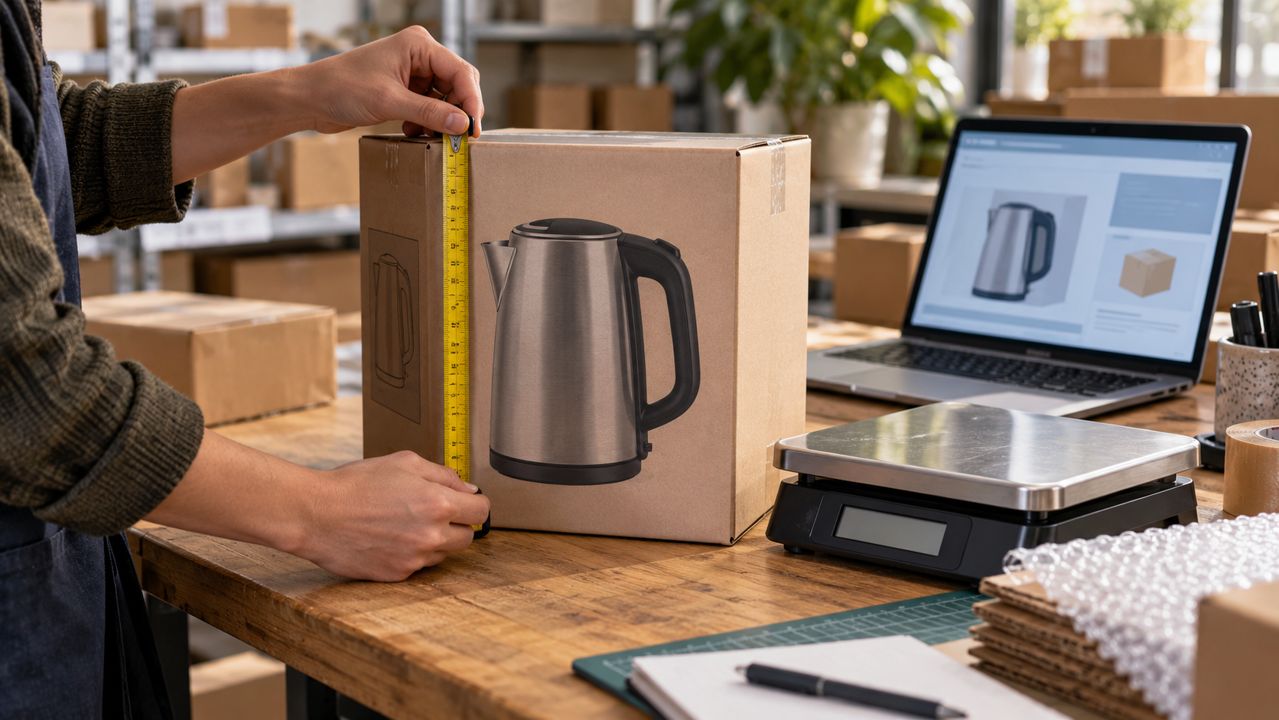
AI-generated illustration.
A supplier offers a product for £8. An apparently identical listing on Amazon shows £20. The difference looks generous until the wrong pack size, selling fees, preparation and a weaker selling price enter the calculation.
Before buying a case, establish what you will actually be selling. Match the model, barcode, quantity per retail pack, condition and included accessories. A single unit cannot be valued against a two-pack listing, and similar photographs do not establish an exact match.
Make sure the listing is relevant to your stock
Check the marketplace where you intend to sell and the product details that matter to its buyers. Regional versions, language on packaging and different accessories can change the proposition. Keep evidence of the supplier's exact offer with the buying calculation.
Also confirm the selling requirements shown in your account for that product and category before committing. Do not treat another seller's live offer as proof that your account can list the same goods. Keep supplier invoices and product provenance organised from the start.
The commercial assessment only becomes useful once the product match and intended selling route are clear. Until then, a margin spreadsheet can produce a very precise answer to the wrong question.
Replace the headline price with a range
The price visible today is one possible outcome. Check whether it is a temporary offer, whether several sellers are competing and whether the product has a stable sales history that you can substantiate. A high listing price does not tell you how many units your own offer will sell.
Run at least a base case and a weaker-price case. You do not need to predict every competitor move. You need to know whether a modest price change would make the purchase unattractive.
In a simplified example, suppose net sales proceeds before marketplace and fulfilment costs are £20. Purchase cost is £8, inbound transport and preparation £1, estimated selling and fulfilment charges £5, and an allowance for advertising, storage and returns £2. The remaining contribution is £4 before general overhead. These are invented amounts on a consistent basis, not Amazon's current fee schedule.
If comparable net proceeds fall to £17 and the other assumptions are held constant for a stress test, contribution falls to £1. In a real calculation, rerun percentage-based fees and any changing cost bands at the lower price. The point is to discover how little protection the initial gap may provide.
Measure the box you will send
Amazon's Revenue Calculator allows sellers to compare estimated revenue and costs for different fulfilment methods. Use the exact product or accurate packaged dimensions and weight. An estimate based on a smaller box is not a saving you can bank.
Compare Fulfilment by Amazon with your own fulfilment using complete costs on both sides. For your warehouse, include picking time, packaging, carrier charges and the service work attached to the order. For FBA, include the relevant inbound preparation and transport alongside the fees and storage assumptions.
Check the current Amazon UK pricing information when making the decision. Fee structures and surcharges can change, so a spreadsheet copied from an old purchase should not be treated as a current quotation.
Buy the test you can learn from
A small first order should be large enough to reveal real preparation and fulfilment costs, but not so large that a wrong assumption becomes months of unwanted stock. Record why you chose the quantity and what result would justify another order.
Review actual proceeds, time spent, returns and stock still unsold before scaling. If the product works only at the highest price you observed, with no advertising and no problem orders, the supplier discount is doing too much of the persuasion.
A good wholesale buy survives a realistic selling price and a complete cost calculation. The most useful number is the contribution left under those conditions, not the difference between two prices found on two different screens.