Amazon expands its Alexa range: the buying questions behind five new devices
Amazon's new smart-home range spans speakers, a display, a clock and a photo frame. Resellers need to distinguish models, markets and service requirements.
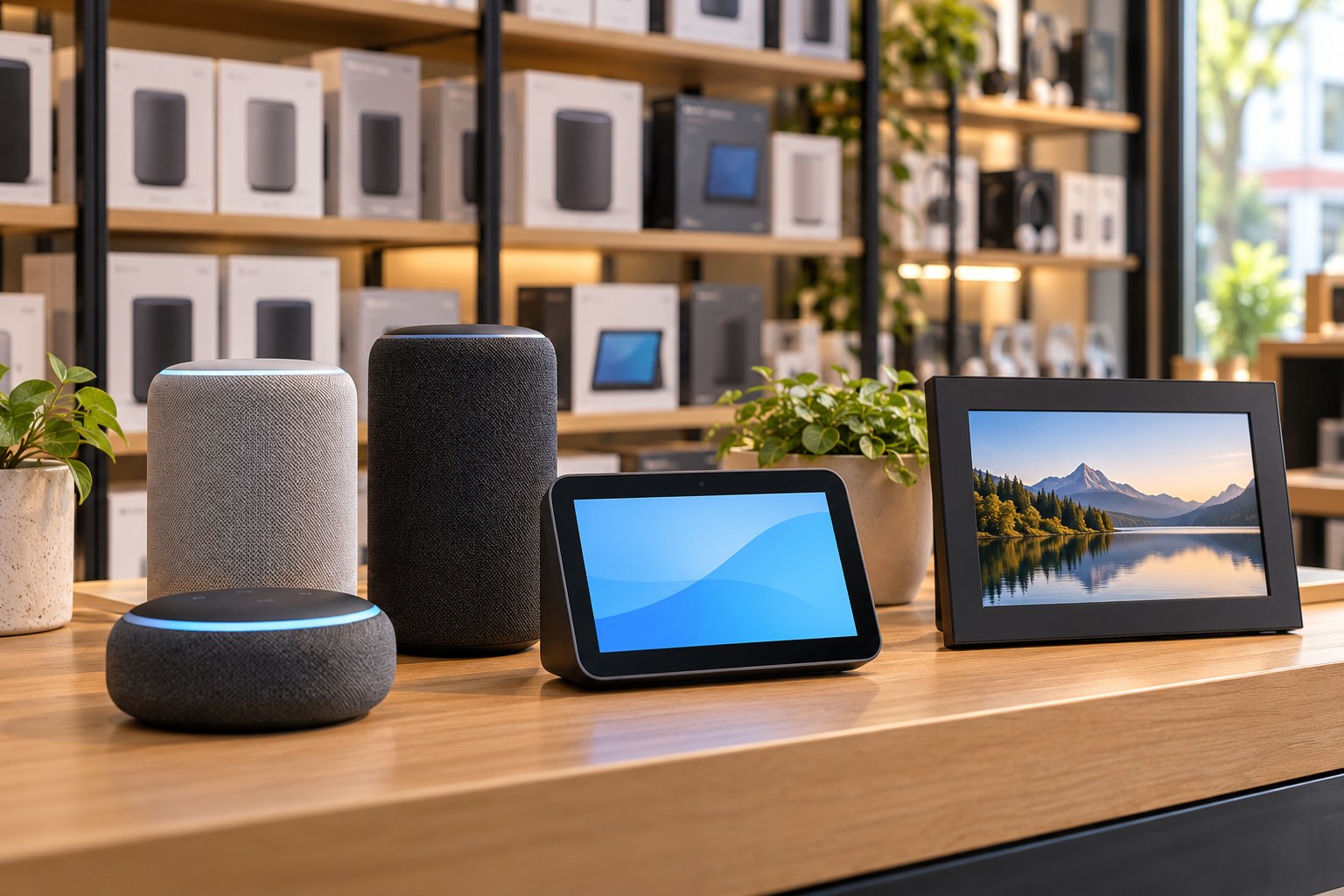
Amazon announced five new Alexa devices on 28 October, extending its connected-home range beyond the familiar smart speaker. For electronics retailers and distributors, the launch creates a range-selection decision as well as a new-product opportunity.
The announced lineup includes a new Echo Dot, Echo Studio with Home Camera, Echo Time, Alexa Photo Frame and Echo Show 16. Amazon lists the new Dot at $99.99, Echo Time at $199.99 and the Studio with Home Camera at $249.99 in its US announcement. Echo Show 16 is offered for preorder from $499.99, with a $100 preorder promotion. These are announced US consumer prices, not wholesale quotations or confirmed pricing for other countries.
A wider range needs a clearer sales explanation
A customer choosing between a speaker, bedside clock and wall-sized display is choosing a use, not simply a faster version of the same product. Retailers can make the range easier to navigate by explaining where each device belongs and what the buyer needs to use it.
Amazon's Show 16 announcement describes a 16-inch display with Fire TV built in and an optional Nanomatte screen. Its speaker announcement identifies smart-home connectivity as a feature of the new Dot. Those differences give shop staff concrete starting points for a conversation about the customer's room, existing equipment and intended use.
The commercial risk is carrying several adjacent products without making those distinctions visible. A larger assortment is not automatically a better assortment if shoppers cannot tell why one item costs more or whether it solves their problem.
Check the market, not just the model name
Before placing a cross-border order, obtain the exact model and market version from the supplier. Confirm the power supply, supported language and services, local warranty arrangements and any account requirements relevant to the destination. Hardware availability in one country does not establish that every advertised software feature is available in another.
Amazon notes that certain features require Alexa+, which is included with a Prime membership. Product listings should explain applicable service conditions accurately rather than implying that every capability follows automatically from buying the box. Check the current destination-market documentation before publishing those claims.
Keep the supplier's written specification with the purchase order. If a shipment arrives with a different market identifier, customer service should not have to work out its implications after the first returns.
Do the margin calculation against the launch offer
An introductory promotion matters to a reseller because customers compare the price they can pay now. A margin forecast based only on the regular headline price may exaggerate the opportunity during the launch period.
Build an order calculation using the realistically achievable selling price, the complete acquisition cost, payment or marketplace charges, shipping and a reasonable allowance for returns. Then test what happens if the public price changes before your stock sells. This is especially relevant when you are committing to a preorder rather than buying goods ready for immediate dispatch.
Existing stock deserves attention too. Identify which older models remain distinct value options and which will be difficult to explain beside the new range. Keep generation names and product identifiers explicit so a discounted older device is not mistaken for the newly announced version.
For an independent reseller, the strongest response may be a selective opening order supported by clear product information, rather than buying every new model. Confirm access through your supplier, identify the use cases your customers actually ask for, and make replenishment decisions from early sales. The announcement gives buyers a reason to review the category; it does not establish demand for every device in every local market.
Related guidance: testing an Amazon product at a realistic selling price.
AI-generated editorial illustration: generic smart-home devices, not the announced Amazon models.